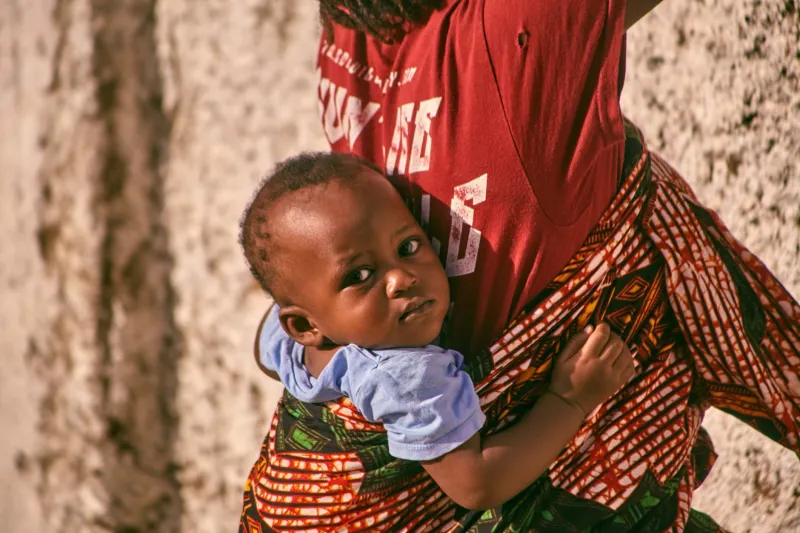
The Sling Stays On (Until Security Asks): Carrying Calmly Through UK Airports
Photo: Mrodica, CC BY-SA 4.0, via Wikimedia Commons
Airports are strange places to be with a baby. Everyone is moving quickly, the announcements are louder than they need to be, and your usual rhythm of feeds, naps and nappy changes suddenly has to fit around a departure board. A sling does not solve all of that. But it does give you one steady thing: your baby close, your hands freer, and a familiar fit in an unfamiliar terminal.
This is not a guide to a perfect airport run. It is a guide to a calmer one, with a few practical checks and a lot of permission to take things slowly.
Before security: a quick fit check, not a full rehearsal
Before you join the queue, run through the basics. Is your baby high enough to kiss easily? Is their face visible and clear? Are the buckles fastened and the fabric snug, without being so tight that you cannot slide a hand under the edge? If you are using a wrap, give the passes a gentle tug to check they are secure. If you are using a buckled carrier, check the waistband and shoulder straps before you add a backpack or a rolling case to the mix.
Dress for the day rather than the destination. Easy shoes, layers you can remove without a performance, and a baby in normal clothes rather than a thick pram suit will make the security dance much less sweaty. Keep your liquids bag, laptop and boarding pass somewhere you can reach without undoing your sling one-handed.
At security: ask before you undo anything
UK airport security can feel like a test with no published answers. Routines vary between airports, terminals and even lanes. Some staff are happy for you to carry your baby through while the sling is checked by hand or swabbed. Others will ask you to take your baby out and send the sling through the tray. Neither response is a judgement on your parenting.
Ask early. A simple 'Do you need me to take the baby out, or can I wear through?' saves a lot of guessing. If you are travelling alone, say so; staff can usually help with trays and bags. Take your time. Put your baby down only when there is a safe, clear space, and never balance them on a security tray. If you need a private area to feed or adjust your carrier, ask for one.
Boarding queues and gate changes: standing is still carrying
Use the sling in the queue if it keeps your baby settled and your hands free for passports, boarding passes and the inevitable last-minute snack. Keep your baby upright, with their face clear and their airway visible. Avoid pulling a coat or blanket over their head to block out the airport lights; if you need shade, use a light muslin and keep checking that your baby is not getting too warm.
At the gate, ask staff how pushchairs are being handled and whether you need to collect anything before boarding. Boarding can be stop-start, and a sling makes those shuffling queues much easier. But a sling is not a safety restraint for takeoff, landing or turbulence. Follow the cabin crew's instructions. If they ask you to remove the sling or hold your baby on your lap with a lap belt, do that, and keep the sling nearby for when you are settled.
When plans go sideways: delays, cancellations and nap maths
Delays happen. Gate changes happen. The departure lounge can become a very expensive soft play centre with worse coffee. Find the quietest corner you can, feed your baby, change their nappy, and give yourself permission to lower the bar. A sling nap in a corner seat is a lovely thing, but it is not a reason to pace the terminal for two hours until your back aches.
If you are delayed overnight, speak to your airline or airport staff about support and what happens next. Keep water and a snack for yourself within reach. And if someone raises an eyebrow at you carrying your baby rather than using a buggy, you do not need to justify your choice. A brief smile and a change of subject is usually enough.
Departure-lounge naps: cosy, but not a duvet
A sleeping baby in a sling can make an airport feel almost civilised. Keep their face visible, check their temperature, and resist the urge to cover them completely. If you are exhausted, do not nod off with your baby in the sling. Ask a travelling companion to take a turn, or use a safe space for your baby while you close your eyes for ten minutes. Airport chairs are not a safe sleep surface for a baby, and a parent who is half-asleep is not a safe carrying surface either.
The cabin and the way home
Once you are on board, keep your changing kit and a spare vest within reach. Cabin aisles are narrow, so a compact bag and a carrier you know well will earn their place. When it is time to disembark, have the sling ready but do not rush the overhead lockers while your baby is dangling. Ask for help if you need it. At the other end, customs and baggage reclaim are just more queues, and the same rules apply: keep your baby close, keep their face clear, and take it one step at a time.
A small kit that earns its place
You do not need much, but these bits make airport carrying kinder: a compact changing mat, a muslin, hand sanitiser, a spare vest and nappy, a water bottle for you, a snack you can eat one-handed, and a small wet bag for anything that gets damp. The best airport carry is the one you can get on and off without a drama.
The quiet gate is not just a place in the terminal. It is a mindset. You are not a problem to be managed, and your baby is not an inconvenience. You are a family getting from A to B, with a sling doing its quiet job: keeping you close, keeping you calm, and leaving one hand free for the passport.