The Grandparent Handover: Teaching Nanny and Grandad to Carry With Confidence

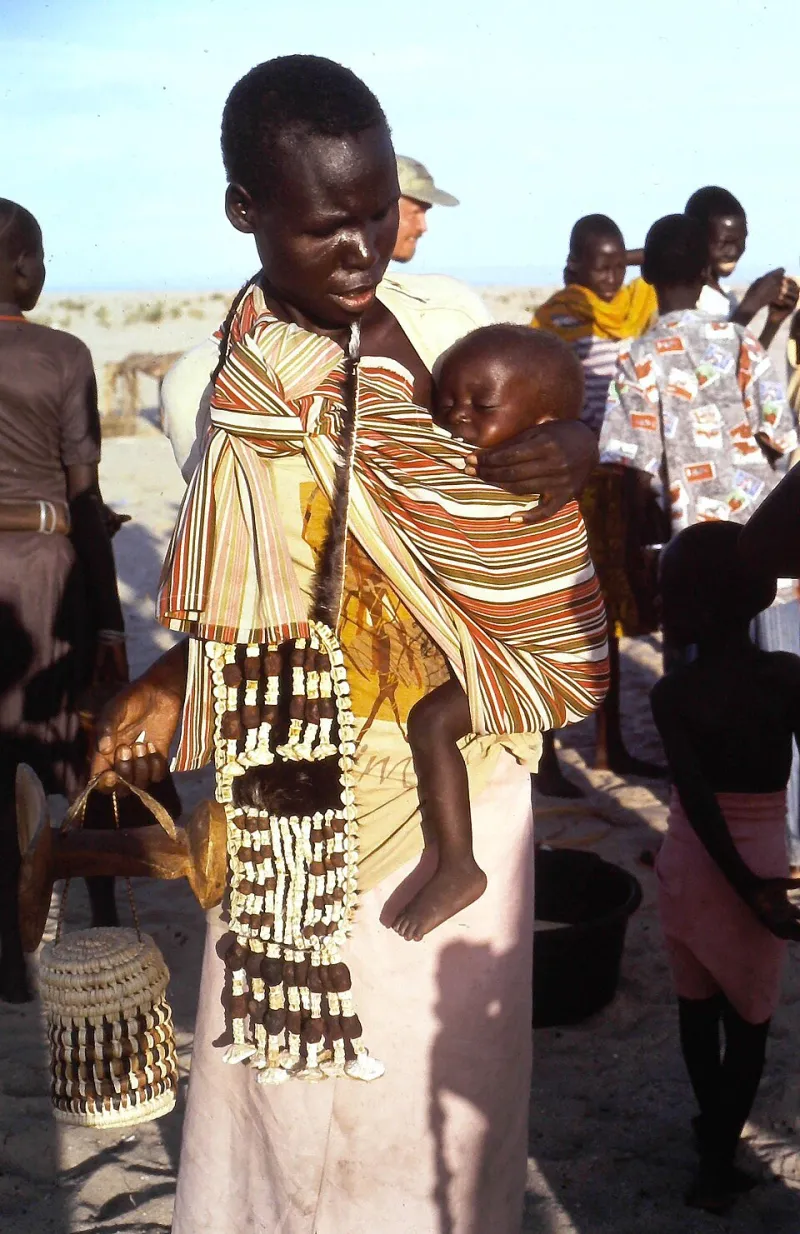
Photo: Courtesy United Nations (Ray Witlin), Public domain, via Wikimedia Commons
There's a particular moment that arrives in most babywearing households, usually somewhere around the third or fourth month, when a grandparent leans over the changing mat and says, with enormous casualness, "So. Could I pop her in that thing?"
If you felt your shoulders rise, you're not alone. It's a lovely request wrapped in a slightly knotty feeling. On the one hand, you'd genuinely love an hour with both arms free while someone else does the bouncing. On the other, the sling is the one piece of kit you've spent weeks learning, and handing it over to a person who last carried a baby in 1989 feels a bit like lending your car to someone who passed their test on a tractor.
The good news: this is very teachable, and it rarely has to become a Thing. Here's how to approach it so everybody comes out of it feeling generous rather than got at.
Start with the assumption they're capable
Most grandparents are far more careful than we give them credit for. They are not trying to attach your baby incorrectly; they simply haven't been shown the current advice, which has moved on considerably since the era of the bag-style carrier and the buckle behind the head. Frame the conversation as updating rather than instructing. "The guidance's changed a fair bit — can I show you the three things that matter?" lands very differently from "you need to do it properly."
It also helps to say yes in principle before you get into the details. "Yes, absolutely, and let's do a practice run this afternoon while I'm here" gives you a natural route into the fit check without it feeling like a test.
The handover script
Keep it short and slightly breezy. Something like:
"Right — here's how I've been doing it. Face is always visible and clear of the fabric, she's close enough that I could tilt my head and kiss her forehead, and the knees sit higher than the bottom, like a little frog. Those are my three checks. Shall I talk you through it while you do it?"
That's it. Three checks, said out loud, once. It gives the relative a clear mental model and gives you a shared vocabulary to come back to later without it sounding like nagging. "How's her face — can you see her nose easily?" is a question, not a correction.
The three checks that really do the work
One: a clear face. No fabric above the chin, nose and mouth completely unobstructed, and no chin-to-chest position where the head tips forward. This is the one to be quietly firm about. Everything else can be gently adjusted over time; this one can't slide.
Two: close enough to kiss. The baby should sit high and tight against the wearer's chest, not swinging low around the waist. If there's a fist-sized gap between them, the carrier needs tightening. It's an easy thing to demonstrate — put a hand in the gap and let them feel the difference once you've adjusted the straps.
Three: knees above bottom. A nice deep seat, knees higher than the hips, with the fabric supporting from knee to knee. Most modern buckled carriers and wraps will do this naturally if the waistband is high and snug enough. Grandparents often find this the most counter-intuitive part — it looks a bit like the baby is sitting in a hammock, which is exactly right — so it's worth a couple of minutes of adjusting together on the sofa before anyone stands up.
If they're keen but not physically confident
Some relatives want to carry and simply don't feel steady, and that's worth honouring rather than pushing through. A few options that keep the warmth without the wobble:
- Seated carries first. Practise putting the sling on and taking it off while sitting down, with you right next to them and a hand hovering. Confidence usually arrives in five minutes.
- Short carries with a clear end point. "Just to the kitchen and back" is far less intimidating than "she's yours for the afternoon."
- Back-up arms. Plenty of grandparents find they'd rather do a hip carry with one arm free than a full two-shoulder buckle. There's no prize for the most technical carry.
- The honourary role. "You do the winding, I'll do the strapping in" is a perfectly good division of labour and often goes down very well.
If a relative has a shoulder injury, recent surgery, balance issues, or simply isn't comfortable standing and walking with a baby attached, the honest answer is a cheerful "not yet — but you can absolutely do the pram today". Nobody's dignity needs to be harmed in the process. "Not yet" is a complete sentence, and it's a kinder one than a hesitant yes.
Setting boundaries without a diplomatic incident
A few phrases that tend to work:
- "I'd love you to carry her — let's do a practice go while I'm here first, then you're off."
- "That carrier's a bit fiddly for a quick handover. Use this one instead, it's much more straightforward."
- "She's due a feed in twenty minutes, so maybe a short one today."
- "Honestly, I'm still getting the hang of it myself. Can we revisit in a few weeks?"
Notice that none of these are refusals of the person. They're refusals of a particular moment, which is a much softer thing to hear. If a relative pushes back, it's usually about feeling trusted rather than about the carrier itself — so name that. "It's not that I don't trust you, it's that I'd rather you felt properly confident before you're on your own with her."
One small thing that pays off
Leave the carrier out on the sofa with the manual, or send them a short video of you doing it up. A bit of quiet homework before the childcare day takes almost all the friction out of the handover. And the first time you come back to find your mother-in-law pottering about the kitchen with your baby asleep on her chest, knees up, face clear, you'll be very glad you took the twenty minutes.
If you'd like a second pair of eyes on the fit, your local sling library is genuinely the friendliest place to take a grandparent — many run drop-ins where a peer supporter can watch them do it up and adjust the straps in real time. It's a lot less loaded than being corrected in your own hallway, and it makes the whole thing feel like an outing rather than an exam.