Loo Breaks and Little Legs: Nappy Changes When Your Baby Rides in a Sling
Photo: Realt0n12, CC BY-SA 4.0, via Wikimedia Commons
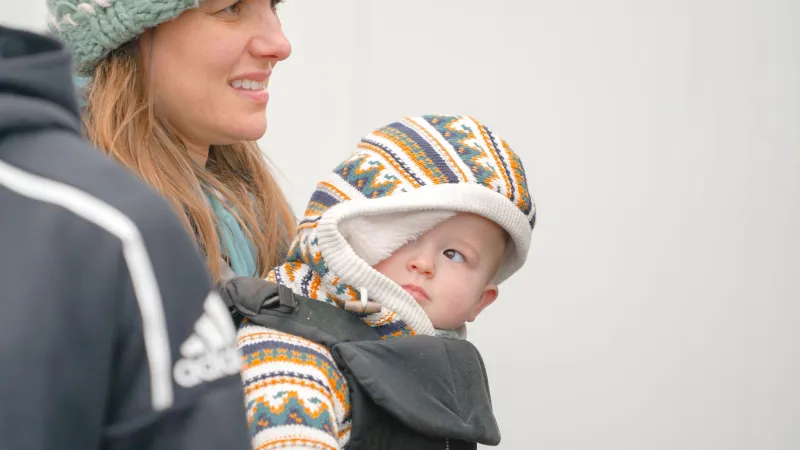
Out for the day with a baby in a sling, you learn to read the signs. There is the innocent sniff. The sudden wiggle. The nappy-change sixth sense that arrives just as you sit down with a cup of tea in a cafe with no obvious loo. It is not the most glamorous part of babywearing, but it is part of the deal. The good news is that a nappy stop does not need to become a full-scale meltdown. With a bit of planning and a lot of kindness to yourself, you can handle the change and get back to your day.
Spotting the window before it becomes a wail
Babies are not subtle about a full nappy, but they can be quiet about it until the moment you are furthest from a changing table. If you are heading out for more than an hour, do a quick check before you leave the house and again before you order food or queue for anything. A baby who has just been changed is often a baby who will happily snooze through the queue at the post office.
It also helps to know your route. In the UK, baby-changing facilities are wonderfully varied. Some cafes have a proper room with a mat and a bin. Some shops have a fold-down table in the accessible toilet. Some National Trust places have a lovely clean parent room, and some motorway services have a baby change that is bigger than your first flat. A little forward planning means you are not discovering the facilities at the exact moment your baby has decided they have had enough.
The change itself: baby out, sling safe
The first rule is simple: never change a baby who is still in a sling. Take them out properly, on a flat and stable surface, with one hand on them at all times. If you are alone, talk to your baby while you work. It sounds daft, but a running commentary keeps you calm and keeps them company.
Before you unclip anything, loosen the straps so you are not wrestling with buckles while balancing a wriggly baby. You can keep the sling on your body with the straps tucked out of the way, or take it off and put it somewhere clean and close. Do whatever feels steady. Lay out your changing mat, get the nappy and wipes ready before you start, and keep the clean nappy within reach. That way you are not rummaging in a bag with one hand while the other hand is doing the important job of keeping your baby safe.
Hygiene matters, but it does not need to be a military operation. Wipe the changing table if it looks grubby, use a nappy sack for the dirty nappy, and clean your hands afterwards. Hand sanitiser is a good friend here. If there is no bin, pop the nappy sack in a wet bag or carry it to the next bin. It is not ideal, but it is better than leaving it on a shelf for someone else to find.
When the facilities are… creative
Public loos in the UK can be a lucky dip. You might find a dedicated baby change, a parent-and-child room, a fold-down table in the accessible toilet, or nothing at all. If the accessible toilet is the only option, use it quickly and leave it clean. And if someone who needs that space is waiting, let them go first. It is a small kindness that makes a big difference.
Cafes and shops are often more helpful than their signs suggest. Ask at the till: “Excuse me, do you have a baby change?” Most staff will point you in the right direction or offer a quiet corner. If there is genuinely no suitable space, your car boot or back seat can work with a mat and the door open for air. A pram bassinet can also be a flat, safe spot if it is stable and you stay right beside it. What you want to avoid is the floor of a busy loo, where bags, shoes and dubious puddles all meet.
Asking for help without the awkward dance
Asking for help is not an admission that you cannot cope. It is just logistics. Try: “I am on my own with the baby — would you mind holding the door?” or “Could you keep an eye on my bag for a second while I change him?” People are usually lovely about it. If someone offers to help, say yes. You do not need to perform perfect independence while your baby is doing a full-body wiggle.
The calm re-entry
Getting the sling back on safely is the bit that can feel fiddly in a small space. Put the sling on first, then lift your baby in close. Check that the straps are not twisted, the fabric is spread comfortably, and your baby is upright with their face clear and close enough to kiss. If they are asleep, take it slowly. A gentle bounce and a quiet word can help them settle back in.
If you usually carry your baby on your back, a cramped public loo is not the place to practise a solo transfer. Front carries are often easier for days when changes are likely. If you are out with a helper, a back carry is fine — just plan who does the lifting and where.
The small kit that earns its place
You do not need a changing bag the size of a suitcase. A foldable mat, a couple of nappies, a pack of wipes, nappy sacks, hand sanitiser and one spare vest will cover most outings. Add a small towel for spills and a change of clothes for the truly adventurous day. Keep it light enough that you can carry it in one hand while your other hand stays on your baby.
A nappy stop is just a pause, not a verdict on your day. If it happens on a cafe floor, in a car boot or in a perfectly lovely parent room, you have still done the thing: you have kept your baby clean, close and cared for. Then you can put them back in the sling, take a breath, and carry on. That is the Liberty Slings version of a successful outing — gentle, practical and entirely human.